According to reports, Iranian sources allege that two missiles were fired at a U.S. naval vessel operating in the region. However, U.S. officials have firmly rejected the claim, stating that no such strike successfully hit an American warship.
(Reference: Iran Claims Two-Missile Strike on U.S. Warship, CENTCOM Denies → https://www.breitbart.com/europe/2026/05/04/iran-claims-two-missile-strike-on-u-s-warship-centcom-denies/)
A Disputed Incident in a Volatile Region
What Has Been Reported
The reported incident highlights the increasingly tense environment in strategic waterways, likely near the Strait of Hormuz—a critical chokepoint for global energy supplies. Iran’s claim of a successful strike contrasts sharply with CENTCOM’s denial, underscoring the difficulty in verifying real-time developments in conflict zones.
Such conflicting narratives are not uncommon in geopolitical disputes, particularly when information warfare and public messaging play a role. Regardless of the outcome, the situation reflects heightened alertness and the potential for rapid escalation.
This latest episode follows a series of confrontations and threats between Iran and U.S. forces, raising concerns about broader regional instability.
Iran’s Strategic Role in the Middle East
A Persistent Flashpoint
Iran continues to play a central role in Middle East dynamics, influencing conflicts through direct actions and proxy groups across Iraq, Syria, Lebanon, and beyond. Its position makes it a focal point in discussions about regional security and global conflict.
From a biblical standpoint, Iran—referred to historically as Persia—appears in prophetic passages such as Ezekiel 38. While interpretations vary, many see Persia’s inclusion as a reminder that this region will remain significant in the unfolding of end-time events.
At the same time, Jesus’ warning in Matthew 24 about “wars and rumors of wars” provides a framework for understanding these developments without jumping to premature conclusions.
What We Know—and What Remains Unclear
Confirmed Information
- Iran claims it launched a two-missile strike on a U.S. warship
- U.S. Central Command denies that any vessel was hit
- The incident reportedly occurred in a strategically sensitive maritime area
Ongoing Uncertainty
- Independent verification of the event remains limited
- The intent behind Iran’s claim—whether strategic messaging or actual engagement—is unclear
- The potential for escalation depends on future actions by both sides
These uncertainties remind us of the complexity and volatility of modern conflict reporting.
Biblical Perspective on Conflict and Uncertainty
Watching Without Fear
The Bible makes clear that global conflict will be a defining characteristic of the last days. However, Scripture also calls believers to approach these developments with discernment and faith rather than fear.
While it would be inappropriate to assign prophetic fulfillment to any single incident, the broader pattern of increasing tension in the Middle East aligns with biblical expectations of a troubled world leading up to Christ’s return.
For further insight into how global conflict connects to Bible prophecy, readers can explore Endtime Ministries’ teachings on world events and prophecy → https://www.endtime.com and watch in-depth analysis on End of the Age+ streaming platform → https://watch.osn.tv.
What Believers Should Be Watching
Discernment in a Time of Conflicting Narratives
In an age of rapid information and competing claims, Christians must remain grounded in truth. Conflicting reports—like those surrounding this incident—highlight the importance of careful discernment and reliance on credible sources.
At the same time, believers should watch for broader trends: increasing military tensions, strategic conflicts over resources, and the growing complexity of international relations.
These patterns, more than isolated events, provide meaningful context for understanding the times.
A Call to Prayer and Steadfast Faith
As tensions continue in the Middle East, Christians are called to pray for peace, for wisdom among leaders, and for protection over those in harm’s way. Scripture reminds us that even in times of uncertainty, God remains in control.
Psalm 46:1 declares, “God is our refuge and strength, a very present help in trouble.” That truth offers stability in a world marked by shifting alliances and disputed narratives.
While headlines may change rapidly, God’s plan does not. Believers can remain confident, watchful, and anchored in His Word as events continue to unfold.
 https://www.endtime.com/wp-content/uploads/2026/05/shutterstock_1973966639.jpg
667
1000
Mika Harris
https://www.endtime.com/wp-content/uploads/2022/08/Endtime-Small-Logo-Blue.png
Mika Harris2026-05-04 20:07:172026-05-04 20:28:14Conflicting Claims as Iran Reports Strike on U.S. Warship, CENTCOM Denies
https://www.endtime.com/wp-content/uploads/2026/05/shutterstock_1973966639.jpg
667
1000
Mika Harris
https://www.endtime.com/wp-content/uploads/2022/08/Endtime-Small-Logo-Blue.png
Mika Harris2026-05-04 20:07:172026-05-04 20:28:14Conflicting Claims as Iran Reports Strike on U.S. Warship, CENTCOM Denies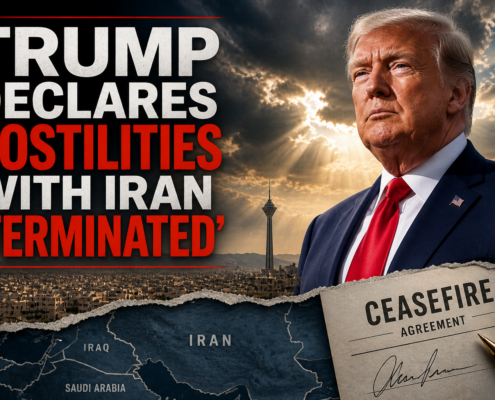 https://www.endtime.com/wp-content/uploads/2026/05/ChatGPT-Image-May-4-2026-at-06_48_26-PM.png
1024
1536
Mika Harris
https://www.endtime.com/wp-content/uploads/2022/08/Endtime-Small-Logo-Blue.png
Mika Harris2026-05-04 19:07:382026-05-04 20:30:03Trump Declares Hostilities with Iran ‘Terminated’
https://www.endtime.com/wp-content/uploads/2026/05/ChatGPT-Image-May-4-2026-at-06_48_26-PM.png
1024
1536
Mika Harris
https://www.endtime.com/wp-content/uploads/2022/08/Endtime-Small-Logo-Blue.png
Mika Harris2026-05-04 19:07:382026-05-04 20:30:03Trump Declares Hostilities with Iran ‘Terminated’ https://www.endtime.com/wp-content/uploads/2026/05/shutterstock_2434817449.jpg
561
1000
Mika Harris
https://www.endtime.com/wp-content/uploads/2022/08/Endtime-Small-Logo-Blue.png
Mika Harris2026-05-04 18:40:322026-05-04 20:31:44Rome Diocese Advances Christian-Muslim Dialogue at Prominent Mosque
https://www.endtime.com/wp-content/uploads/2026/05/shutterstock_2434817449.jpg
561
1000
Mika Harris
https://www.endtime.com/wp-content/uploads/2022/08/Endtime-Small-Logo-Blue.png
Mika Harris2026-05-04 18:40:322026-05-04 20:31:44Rome Diocese Advances Christian-Muslim Dialogue at Prominent Mosque
Leave a Reply